
Reconnecting the Family Roots

“Dear Relative!
“Please excuse this salutation, but I wonder if you are not related to us, since the name Weinhardt is rather rare in my opinion...”
At the end of April 1923, a letter from the small town of Schwabach, located near Nürnberg in Bavaria, left Germany and traveled to Indiana in the United States. Fifteen-year-old Hans Weinhardt wrote the letter in hopes that it would reach William Weinhardt, a man he had never met who might be a distant cousin of his father, Johann Weinhardt. The story that unfolds can now be traced through the dozens of letters that make up the Weinhardt Family Collection. Over the next seven years, Hans Weinhardt would leave his family behind to live in Indiana and build a new life there while maintaining his ties to his parents and siblings, expressed in their frequent correspondence.

Hans Weinhardt’s first letter to William Weinhardt
April 26, 1923
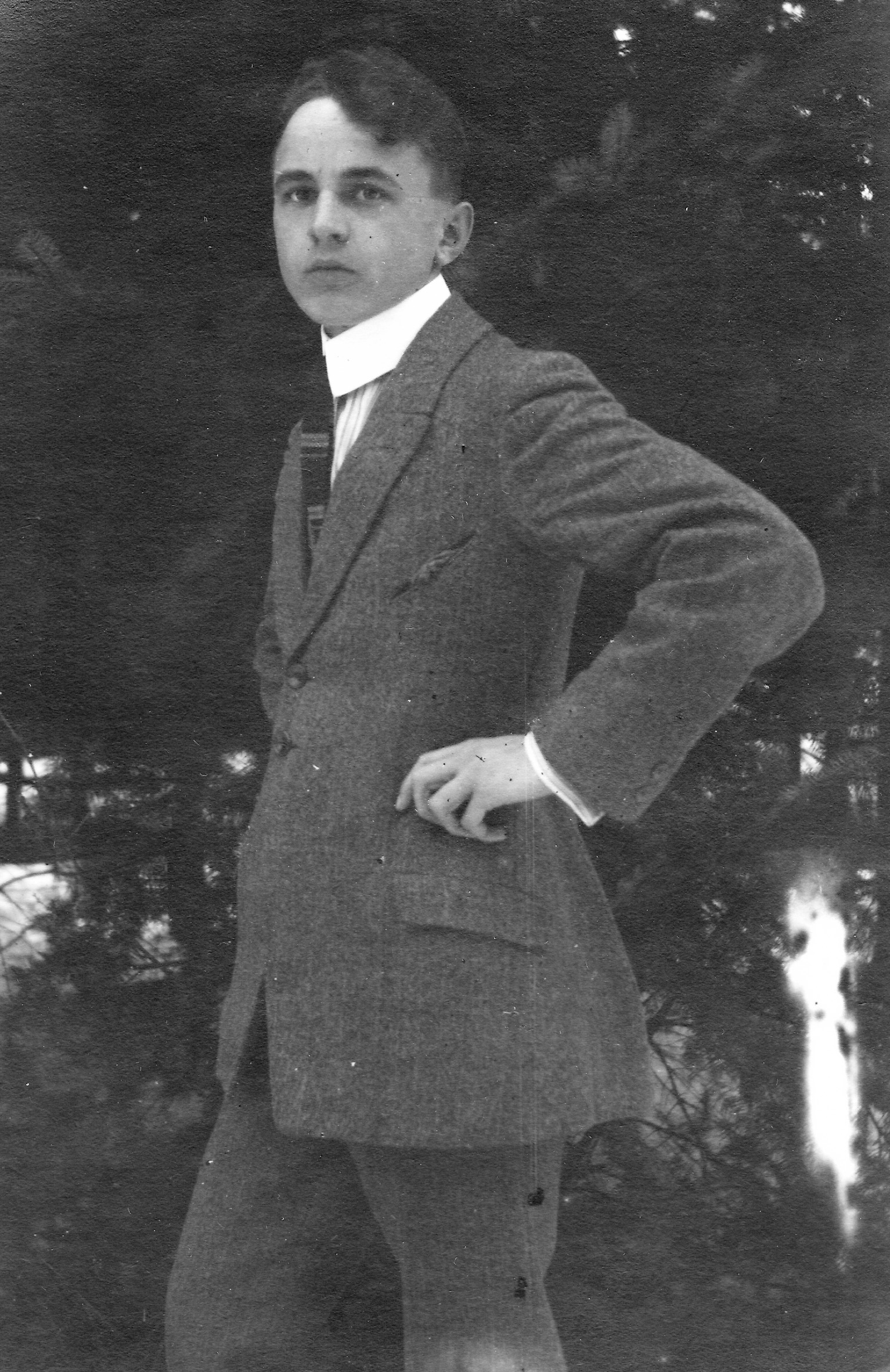
Photograph of Hans Weinhardt, 1924
“Until recently,” Hans wrote in his first letter to William Weinhardt, “we had no knowledge of any relatives in America.” While working at the Schwabach town hall as a Stadtratsinzipient—a kind of apprenticeship—Hans decided to research his family history. “To that end,” he explained, “I rummaged through old documents at our city hall, since all our forebears lived in Schwabach, and I found a record of emigration for a Weinhardt family.” The documents recorded that a father and son named Weinhardt had left Schwabach for Fort Wayne, Indiana in 1848, followed by six other members of the same family the next year.1 Thanks to family acquaintances living in Independence, Indiana, he had learned of a William Weinhardt living in Lafayette, and obtained his address from the city police. “We would be thankfully indebted to you if you could tell us about the descendants of this family so that we could complete our family tree,” Hans concluded. “We would appreciate hearing from you soon.”
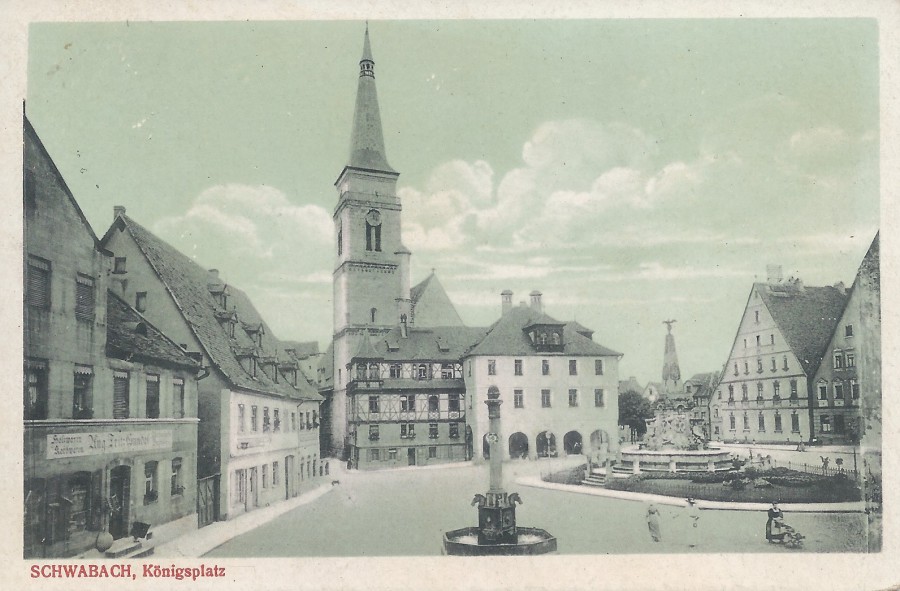
Photograph of Schwabach’s main square, the Königsplatz, ca. 1919. The white building with five arched entryways at the center is the Rathaus (town hall), where Hans Weinhardt first found records of his Weinhardt relatives’ emigration to the United States. Courtesy of Detlef Ott, www.ott-schwabach.de
The Weinhardt family had roots in Schwabach going back many generations. Hans’ father, Johann, was born there in 1869. He had learned goldsmithing, a traditional handicraft in Schwabach, but was conscripted into the German army in 1889. He married Margarete Riebel, the daughter of a farmer, and the couple had four children: in addition to Hans, their third child, they had two older daughters, 22-year-old Marie and 21-year-old Johanna, and a younger son, Philipp, age fourteen. After being discharged from the military, Johann joined the civil service and worked as a jail superintendent in several communities, eventually returning to Schwabach in 1918 with his family to take up the administration of the jail in his hometown. The Weinhardt household in 1923 included the parents and all four children: while Hans and Philipp were in school, Marie worked as an office clerk in Nürnberg and Johanna was a seamstress. The aftermath of the First World War had been difficult for the Weinhardts, and the family was hopeful they might have relatives overseas able to offer them advice and assistance.
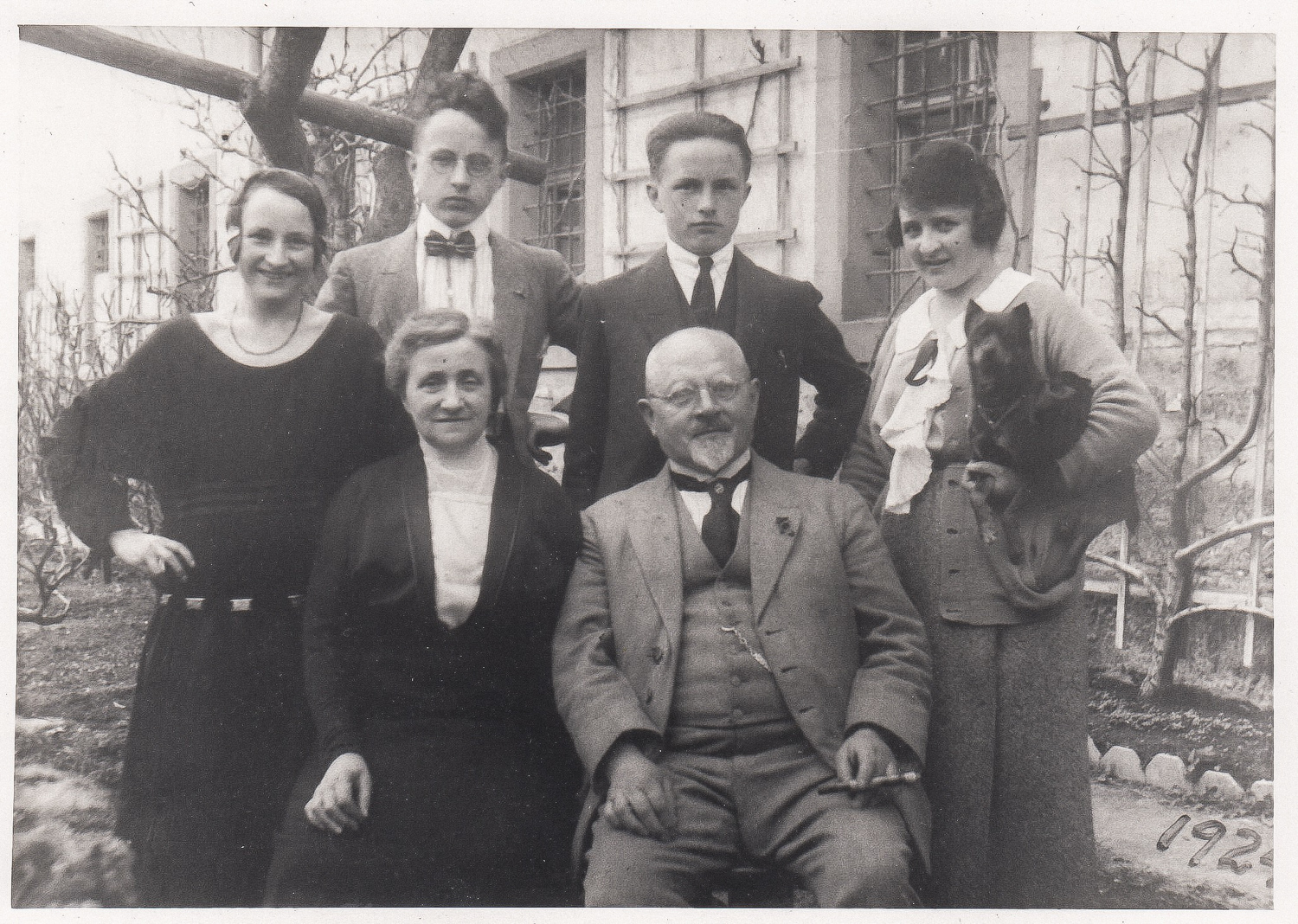
Photograph of the Weinhardt family, 1924. Standing, left to right: Johanna, Hans (John V.), Philip, and Marie. Seated: Margarete Riebel Weinhardt and Johann P. Weinhardt.

Two months later, a letter from Lafayette, Indiana reached the German Weinhardt household with a message from William Weinhardt, who confirmed that he was likely one of Hans Weinhardt’s distant cousins.2 The response shared the details of his connection to Schwabach: the emigrant who left Schwabach, Johann Michael Weinhardt, was William’s grandfather. He had owned a brewery and a small garden restaurant in Schwabach but decided to move to the United States in 1848, with his oldest son, Hermann, who was William’s father, in 1848. It was Johann Michael’s wife Babette and their five other children who followed a year afterward. The families eventually determined that William’s grandfather, the emigrant Johann Michael Weinhardt, was the first cousin of Johann’s grandfather Johann Georg Weinhardt. The letter was actually written on William’s behalf by an elderly friend, John Yungmeyer, who himself was originally from the Schwabach region. Yungmeyer explained that he had translated Hans’ original letter because William did not know German. Despite not knowing the language, William’s letter declared that he would enjoy learning more about his newfound relatives and continuing the correspondence.
The First Letters
In his second letter to William, written on June 25, Hans explained that “my greatest wish would be to someday come to America to visit my relatives and to further my education as a businessman.” In an August 7 letter, he elaborated on the multiple problems Germany was facing. Most of Schwabach’s renowned goldsmithing firms were idle, while for those who worked rapidly mounting inflation meant workers’ purchasing power fell from one paycheck to the next. Meanwhile, the city office where he worked was visited by dozens of people a day seeking housing. He emphatically declared “I would very much like to get to the ‘New World’ and try my luck there.”3 Responding to Johann’s letter, William offered that if Hans came to the United States he would “do everything in my power to see that he is taken care of until he could secure a good job.” He added that he would even be willing to pay Hans’ travel expenses, although he was not currently in a position to do so, with the expectation that Hans would reimburse him after he found a job.4


Letter from Johann Weinhardt listing the high prices created by inflation.
The letters exchanged between Lafayette and Schwabach quickly established strong ties between the two families. Hans’ father, Johann, also wrote to his American cousin and described the family’s hardships as a result of the First World War and the German Revolution of 1918. The money he had saved over the course of his career was trickling away, and prices rose “constantly and unendingly.” He cataloged the results of the inflation of the German Papiermark, driving the price of shoes up to 400,000 marks and the price of a suit as high as 800,000 marks. William sent the family five U.S. dollars and in a subsequent letter Johann noted that he had used the money “to stock up on flour.” Hans met an acquaintance of William who was visiting Munich and evidently made a good impression. Before the end of the year William was seeking Johann’s advice on buying a gold Swiss stopwatch and the young Weinhardts in Schwabach were calling William Weinhardt and his wife, Carrie, “Uncle” and “Aunt.” Their newfound American relatives surprised the Weinhardts in Schwabach by sending a Christmas package full of clothes, including caps, shirts, and stockings for Hans, his parents, and his three siblings.5
Hans’ mother, Margarete, and his sisters, Johanna and Marie, wrote to William in January, 1924, to thank him for the package they had received. They also shared the news that the family was making plans to move to Windsheim, a town a short distance from Schwabach. Over the following months, William reiterated his invitation to Hans to come to the United States, though unreliable mail service caused delays in the cousins hearing from each other. In August 1924 William even informed Hans that he had purchased a ticket for him, but it would only remain valid until the end of October. American immigration laws, however, led to further delays in Hans’ journey.6